If you live (or have lived) in Clifton Park, you know the best pizza spot, the best Clifton Park Facebook page, and probably exactly how long you’ll sit at the intersection of 146 and Rt 9.
But Clifton Park has secrets 😳. Stories buried under the strip malls and subdivisions. And if you dig just a little, you’ll find a town with a history richer than some people realize.
Here are ten things about Clifton Park that’ll make you see this town a little differently:
1. We Used to Be Halfmoon
We here at Clifton Park Spark get a lot of hate mail when we post about Halfmoon, make it make sense!
But Clifton Park didn’t just appear out of nowhere in the 1960s. The town was officially formed in 1828, but before that, we were simply the southern half of Halfmoon.
The split happened because Halfmoon had grown too large to govern as one town. So they drew a line, they split it in… half, and Clifton Park became its own place.
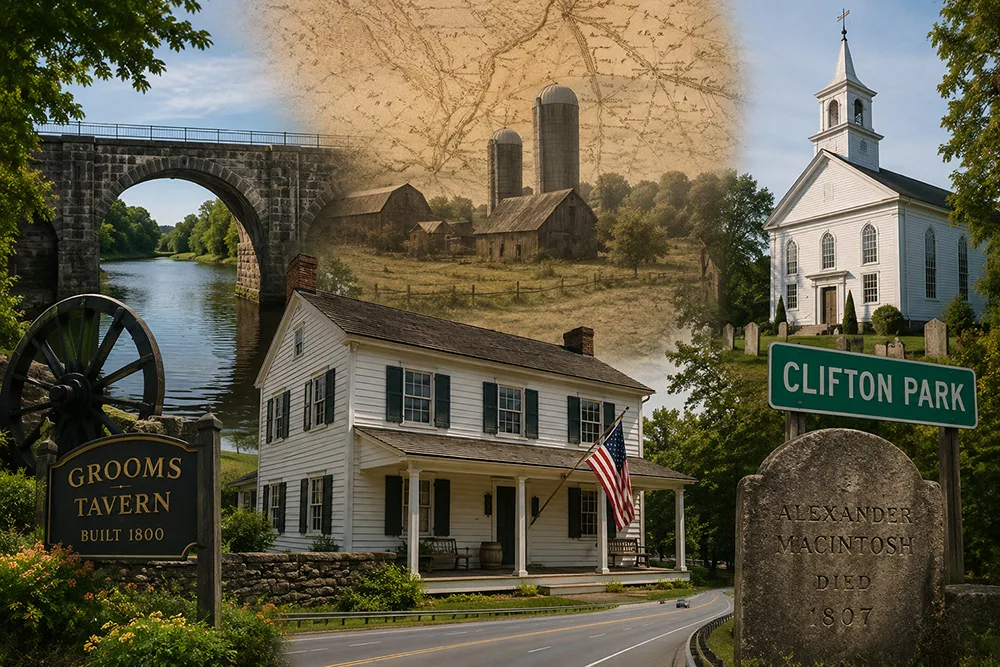
And the very first town meeting? Held at a building that still stands today: Grooms Tavern.

2. “Clifton Park” Is Older Than the Town Itself
The name “Clifton Park” actually existed long before the town did.
It comes from the Clifton Park Land Patent, granted in 1708, over a century before the town was incorporated. European land speculators claimed the territory, slapped a name on it, and went about their business. The name stuck around so long that when the town finally needed one, “Clifton Park” was already waiting.

3. The Mohawk and Mohicans Called It “Canastigione”
Before any of that, this land had a very different name.
The Mohawk and Mohican peoples who lived along the Hudson and Mohawk Rivers knew the area as Canastigione — roughly translated as “Corn Plains.” They farmed the fertile land near the river, growing corn and living in a landscape that looked nothing like the suburb we know today.
So when you drive past Clifton Country Road, remember: people were growing food here over 300 years ago.

4. The Erie Canal Ran Right Through Here
We all know the Erie Canal, but did you know it passed through Clifton Park?
The Crescent Aqueduct in Halfmoon and the Rexford Aqueduct in Clifton Park carried the canal across the Mohawk River, pushing 13 miles into Saratoga County. When the canal opened in 1825, it turned this quiet farming region into a corridor of trade and travel. Farmers could ship goods. Travelers could move west. Clifton Park was suddenly on the map, literally.

5. We Were All Farms Until 1960
Hard to picture now, but Clifton Park was pure countryside until the Adirondack Northway (I-87) arrived in the early 1960s.
Before that? Dairy farms. Apple orchards. Ice-making operations along the Mohawk. Sawmills and gristmills dotted the landscape. The town’s population was tiny, spread out, and deeply agricultural.

Then the highway came. And everything changed.
6. Grooms Tavern Is Nearly 225 Years Old
Built in 1800, it started as a grocery store before James Groom turned it into a tavern in 1828, the same year Clifton Park became a town. For decades, it was the meeting place. Town business, local gossip, probably a few arguments about politics. The whole deal.
The town bought it in 1999, restored it, and reopened it in 2007 as a historic and cultural center. So yes, you can literally walk into a building where Clifton Park’s first leaders sat down and said, “Alright chat.. we’re doing this.”
7. There’s a Church in Vischers Ferry from 1802
Cross the river into Vischers Ferry and you’ll find the Friendship Church, founded in 1802 when the Dutch Village congregation decided to set up shop on this side of the Mohawk.
The original building burned down, but the current sanctuary was rebuilt in 1888 and still stands. That’s over 140 years of continuous worship in a building that watched Clifton Park go from farmland to suburbia.

8. Shenendehowa Wasn’t Always “Shenendehowa”
Shenendehowa Central Schools opened in 1950 under a much less exciting name: Central Schools District No. 2.
The name “Shenendehowa” came later, pulled from old Dutch maps that labeled the area as such. It means “Great Plains” in Iroquois, a nod to the flat, fertile land the original inhabitants farmed.

9. A Revolutionary War Captain Is Buried Here
Nanning Vischer, a captain in the American Revolution, was buried in the Nanning Vischer Cemetery in 1813.
His family were among the earliest European settlers in the region, and the Vischer name still echoes through Clifton Park and Halfmoon today.

10. One of the Oldest Marked Graves Dates to 1807
At the site of the former Grooms Methodist Episcopal Church is Macintosh Cemetery, there sits the tombstone of Alexander Macintosh, dated 1807.
Alexander was actually the father of John Macintosh, who was famous for the apple called “Macintosh Red.”
Anyways..
Clifton Park has a rep for being new. Subdivisions. Strip malls. Chain restaurants. And, a lot of it is new.
But underneath all of that is a town that was farmland, then a canal town, then a highway suburb. It’s a place where Revolutionary War captains are buried, where 225-year-old taverns still stand, where the name on your high school diploma predates the school by centuries.